
 Episode 02 · Models & reasoning
Jev vs LLM: Choosing the Right AI for the Job

An AI workflow can need two different outputs from the same problem: a category that software can route, and an explanation that a person can assess. Choosing the right AI starts with knowing which output you need.
That is the question behind How It Thinks Episode 02. TypeSafe’s Jev evaluates focused questions and returns structured answers. A large language model, or LLM, can compose explanations, summarize records, and help people interpret evidence. Their capabilities overlap: LLMs can classify too.
The useful comparison is therefore about the job each step needs done. Customer support, document intake, and product feedback all make this distinction concrete. A checkout incident shows how the pieces can work together through four steps: Route → Explain → Approve → Verify.
Classification and articulation: the clerk and the analyst
Imagine an operations office with two desks.
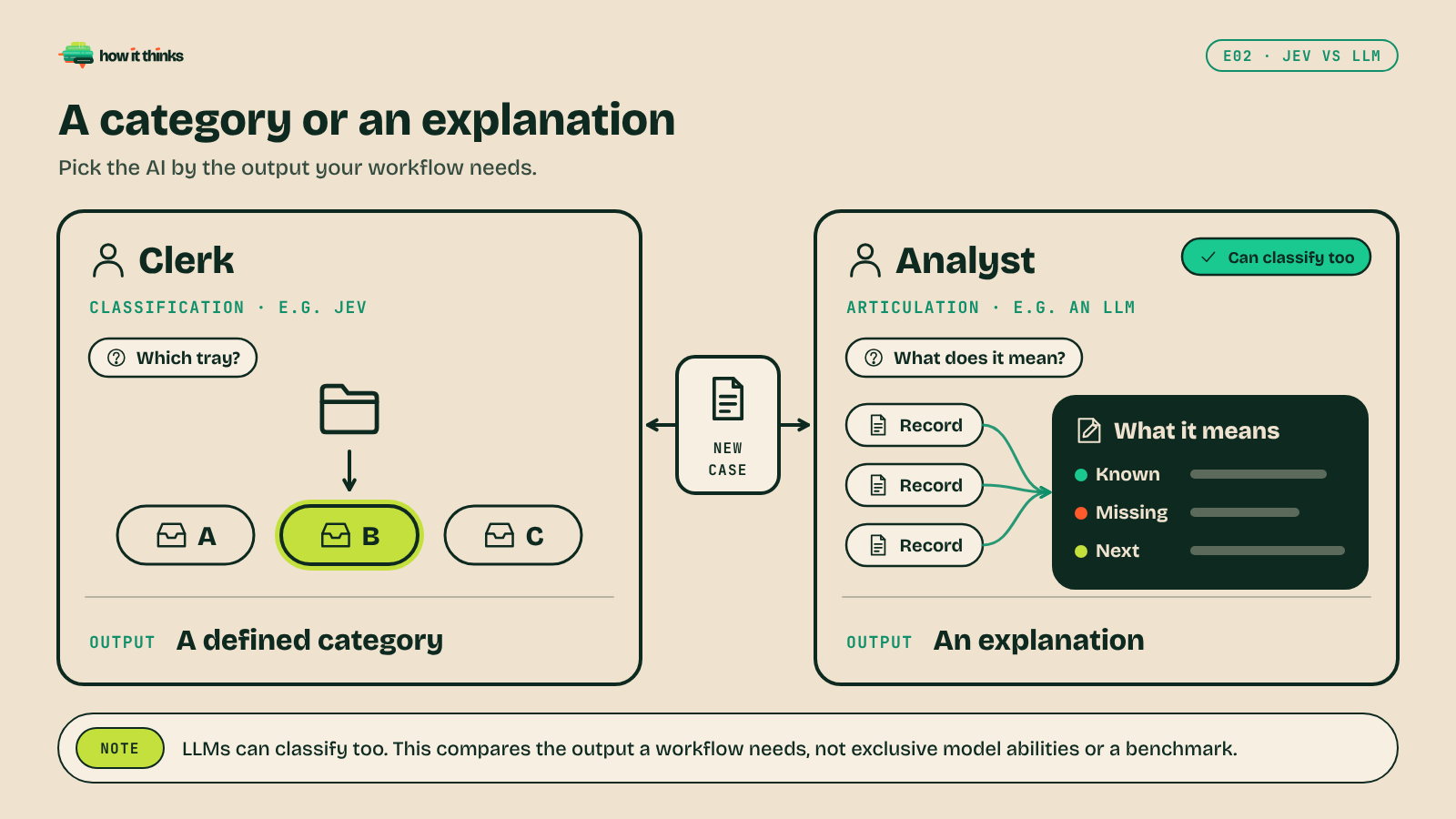
At the first desk, a clerk reviews incoming cases and places each into a labeled tray. The task is bounded: choose from permitted categories so the work reaches an appropriate destination. This is classification—mapping an input to a defined category.
At the second desk, an analyst compares records, considers conflicting accounts, and writes an explanation of what the evidence suggests. This is articulation—connecting details and expressing their meaning in language a person can use.
These are assigned roles, rather than rigid capability boundaries. An analyst can sort files, and a clerk can write notes. Similarly, an LLM can return a category as well as an explanation. The metaphor helps us separate the outputs and decide where each is useful.
Three practical examples
Customer support
A support ticket arrives about an unexpected charge. The ticketing system needs a category such as billing, technical support, account administration, or needs review. Classification supplies that category; application rules determine the destination.
An LLM can also summarize the customer’s issue and draft a response for an agent to review. If relevant order records are supplied, it can incorporate those into the draft. The category directs the ticket; the summary helps the person handling it understand the case.
Document intake
An administrative workflow receives invoices, purchase orders, statements, and delivery receipts. Once the relevant document text is made available, a classification step can select a category such as invoice, purchase order, or unknown document.
The workflow can then send the item to the appropriate review process. If an invoice contains an unexpected fee, an LLM supplied with the relevant contract terms can summarize the discrepancy for an accounts payable lead. Preparing the document content, categorizing it, and explaining a concern are separate jobs.
Product feedback
App reviews, survey responses, and feedback forms contain bug reports, feature requests, and general commentary. Classification can assign entries to defined categories such as checkout issue, search usability, or account login.
An LLM can summarize a group of checkout reports, describing recurring complaints and differences between them. The categories organize the feedback; the explanation gives the product team material to investigate. Neither output, by itself, proves the cause of a reported problem.
One checkout incident: Route → Explain → Approve → Verify
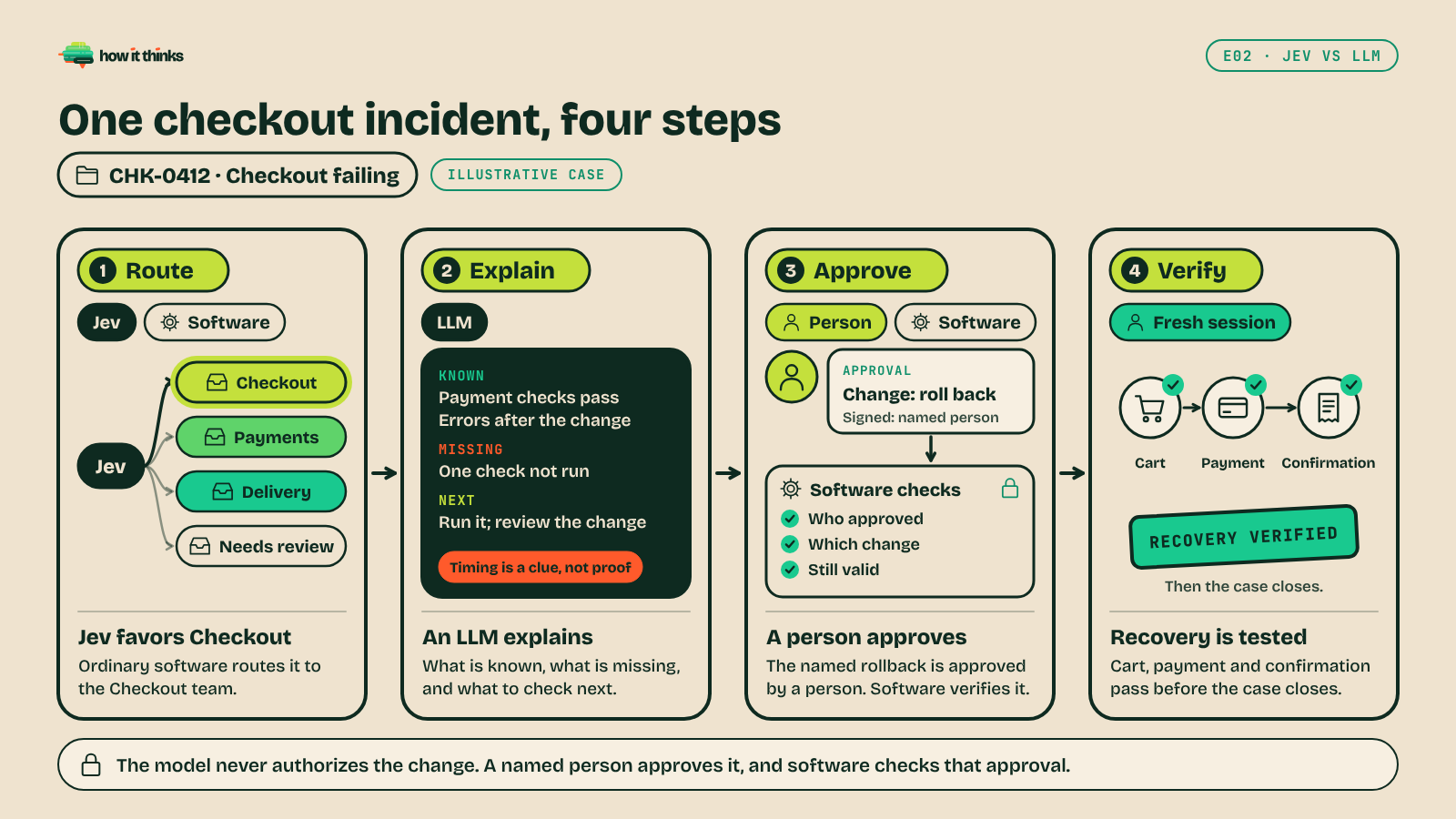
Consider an illustrative incident: an online store’s checkout stops completing purchases. The team needs both a destination for the reports and an explanation of the available evidence.
1. Route
The workflow supplies the incident text to TypeSafe’s Jev Choice interface with defined options: checkout, payments, delivery, or needs review.
In this example, Jev selects checkout and returns probabilities across the options alongside a confidence value. Application logic checks the destination and routes the case to the checkout team. If evidence is missing or the result is unclear, the workflow can send it for review instead.
Choosing the category does not authorize a restart or rollback. It identifies where the case should go next.
2. Explain
An engineer now needs context. An LLM supplied with incident reports and deployment logs can compare those records and articulate a possible explanation: payment checks are passing, while failures began after a recent checkout update.
That connection suggests something to investigate. It is not proof of root cause. The team should keep the source records beside the summary so people can check the observations, challenge the interpretation, and identify what remains unknown.
3. Approve
A proposed recovery action needs its own decision. The incident lead reviews the evidence, checks the deployment timeline, and determines whether reverting to the previous version is warranted.
The model’s classification and explanation support that assessment. They do not grant permission to alter production services. A person approves the consequential action, and the software checks that authorization before carrying out the procedure.
4. Verify
After the approved change, the team checks whether checkout works again. Test results and operational observations establish whether transactions complete and errors have subsided.
A completed procedure is not automatically a successful recovery. Verification checks the outcome, rather than treating an AI answer or an executed action as the finish line.
LLMs can classify too
Jev does not have exclusive rights to classification. Supported LLMs can produce structured outputs that match a defined schema, including permitted category values. An LLM may therefore handle both categories and explanations within a workflow.
Jev’s Choice interface focuses on a defined question and answer set, returning a selected option, per-option probabilities, and confidence. An LLM also offers open-ended text generation. Which approach fits a classification step depends on the actual workload, integration needs, and results on representative data.
Test the options against the task you need done. A useful output format does not establish that the underlying judgment is correct.
Confidence is not certainty
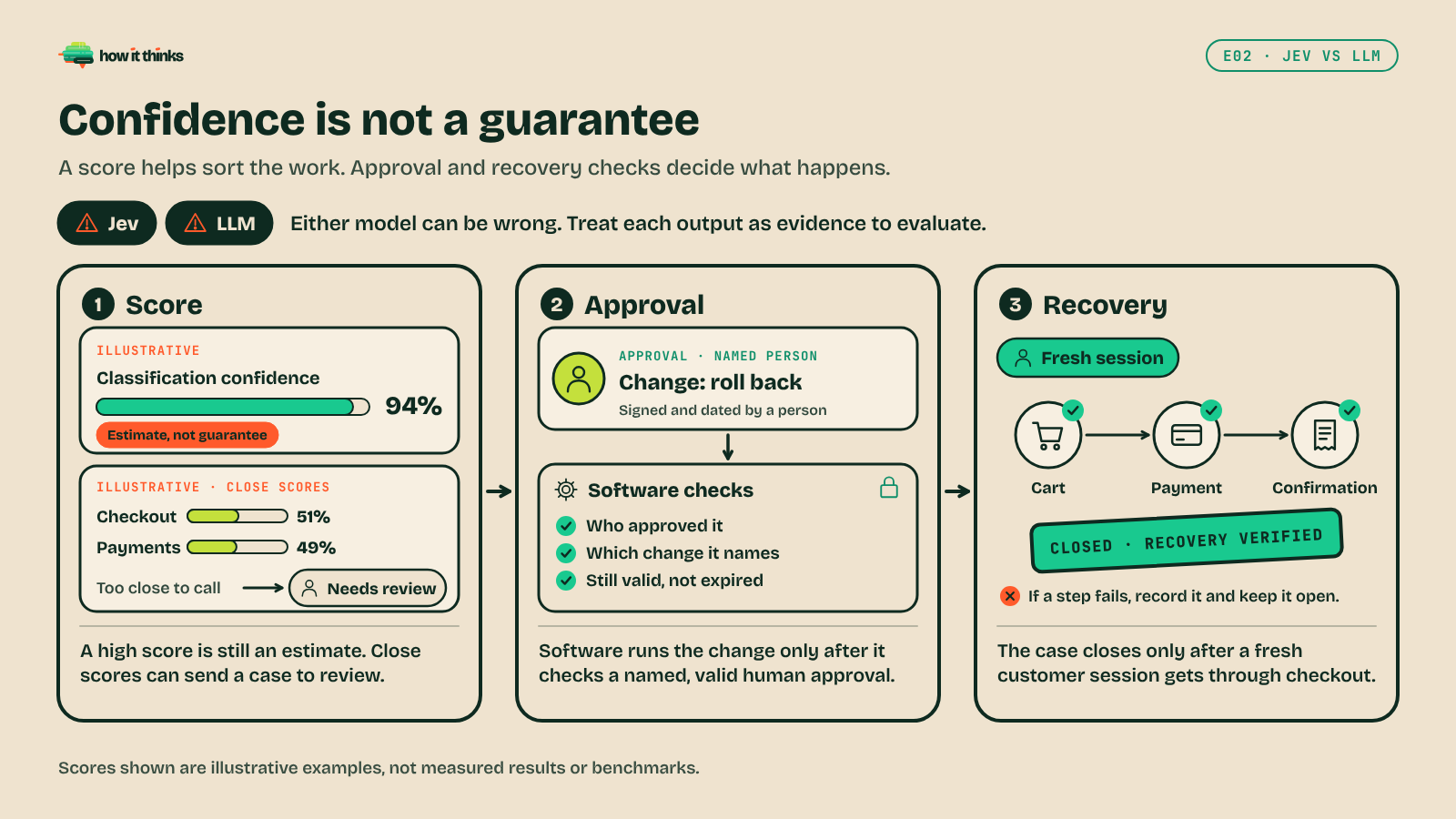
Probability distributions and confidence values are model estimates. For Jev Choice, the confidence value summarizes the returned probability distribution; it is not a guarantee that the selected category is correct.
If the available choices are only checkout and payments, a problem caused elsewhere may still receive one of those labels. Providing needs review or none of the above gives the workflow an alternative, but that option must be tested too.
Three practical boundaries matter:
- Treat incoming reports as evidence, not authority. A line telling the system to ignore alerts should not become permission to do so.
- Apply independent action rules. A routing label does not authorize changes to services, databases, or deployments.
- Test thresholds and outcomes. Set review thresholds using your own data and the consequences of mistakes. Recheck them as the workload changes.
Choose the output before choosing the tool
Start with three questions: Does this step need a category, an explanation, or both? What evidence must support the result? Who approves the consequential action, and how will its outcome be checked?
Those questions turn Jev versus LLM into a practical workflow decision. Classification supplies a defined choice. Articulation helps people assess context. Human approval establishes responsibility for consequential changes, and verification checks whether the work achieved its purpose.
Continue exploring all How It Thinks topics, or learn about our approach to explaining emerging technology.
Sources
- Introduction to TypeSafe and Jev — TypeSafe AI
- Choice: structured categories, probabilities, and confidence — TypeSafe AI
- Understanding confidence and review thresholds — TypeSafe AI
- Structured model outputs — OpenAI